
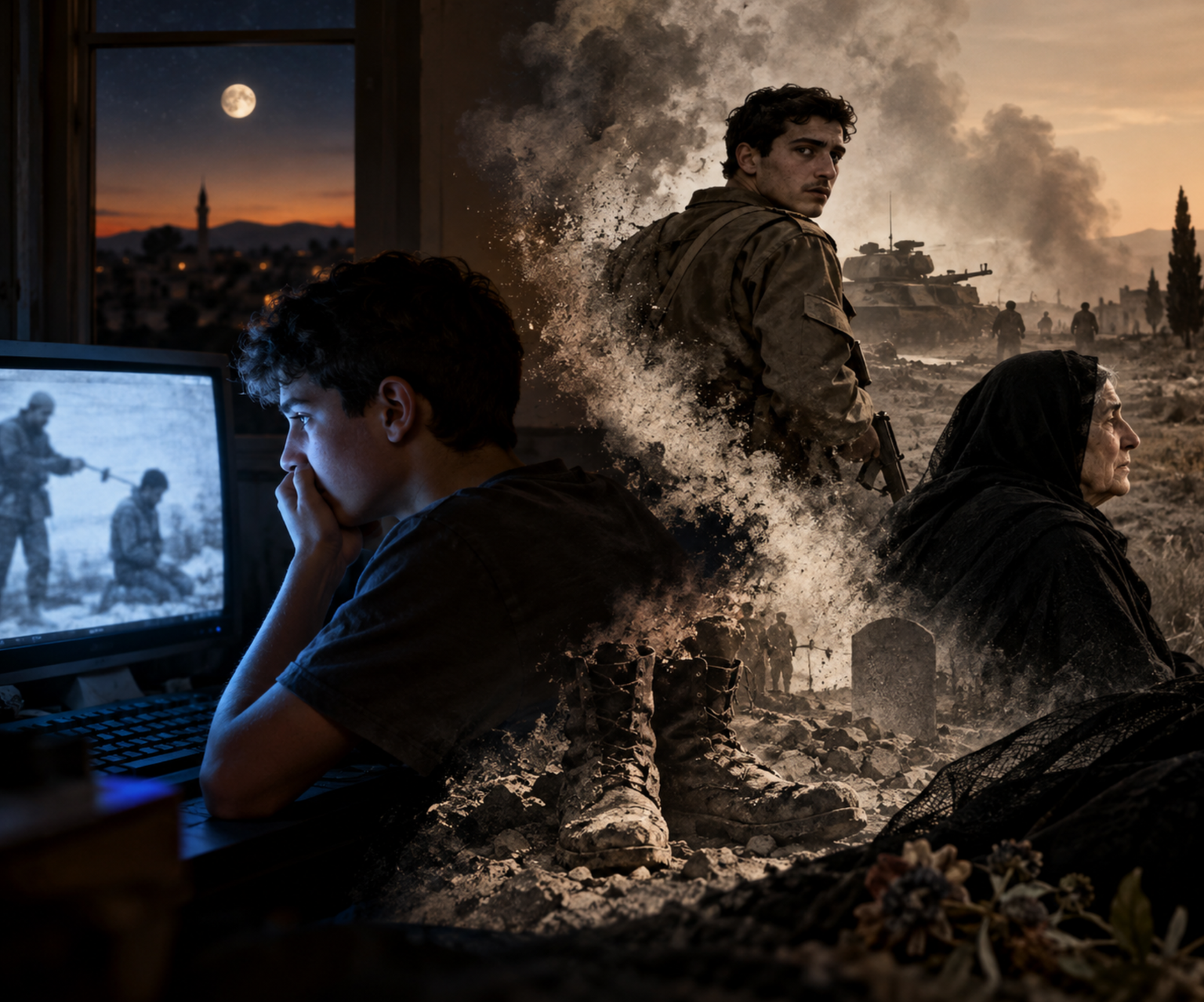

That is the strange alchemy of trauma. You experience something that reshapes your entire psychological landscape, yet your brain locks away the actual footage, leaving you with nothing but the raw, heavy anchor of how you felt. I see this split-screen layout in my mind when I think about my family. Two different generations of young boys in the Levant, both trying to escape violence they weren’t ready for, and both tracking the limits of what a human mind can bear to remember.
In early 2000, I was barely 14 years old. With a single dollar to my name, I would head to the local internet shop with my friends to rent a desktop for an hour. My friends spent their time playing video games. I was terrible at it. If I joined, I’d get headshotted within the first minute, and everyone would mock my skills. To feed my curiosity and save my pride, I surfed the web instead. I thought I was choosing the safer, quieter path.
Years earlier, in 1984, my uncle Gazi was facing a much more lethal game. The Lebanese Civil War had been raging for nine long years. Gazi was a young, handsome man who had joined the Lebanese Army and found himself deployed to a tense region, right near the front lines. For reasons he never shared with a soul, Gazi didn’t feel right. Like me walking away from the computer screen, Gazi decided he wanted out. He deserted his unit, walked away from the front lines, and went home.
But in our region, escaping the narrative of violence is never that simple
When Gazi arrived home, he was met by my late grandfather—a tough, rigid man who was impossible to reason with. My grandfather flipped. He told Gazi that deserting wasn’t manly, and that he had to rejoin his unit immediately. Torn between the threat of court-martial and the crushing disapproval of his father, Gazi chose what felt like the path of least resistance: he went back to the front lines.
The trap snapped shut on both of us
At my computer desk in 2003, my curious clicking led me to a video. It showed two masked men executing a captured victim in the chaotic aftermath of the Iraq invasion. Saddam was on the run, and the region was bleeding out. I didn’t know the politics then; we only had news if our TV antenna worked, and my worldview mostly came from an old brown radio in my grandfather’s house. I couldn’t comprehend what I was seeing or hearing. Today, I cannot picture the background, the masks, or the victim’s face. But I still remember my heart dropping into my stomach, and a sudden, violent urge to vomit.
For Gazi, the end came at early dawn. A militia broke into their fortification. Some elements within his unit collaborated, and it turned into an absolute bloodbath. Dozens died; dozens more were mutilated and went missing. Gazi’s tank was hit, but a survivor later reported seeing him escape the wreckage, alive, desperately firing his rifle into the smoke. Because the battle kept raging, the dead were left rotting in the open sun for days before anyone could retrieve them.
Around the time I forgot about that execution video, I started noticing that my grandmother was always dressed in black. As a kid, I just assumed she loved the color. I reasoned that the long black dress and black scarf were just her fashion preference for taking care of her cows and her flock of rebellious chickens.
But one night, my curiosity got the better of me, and I asked my dad why she always wore black
That was the night my dad told me about his late brother, Gazi. He told me about the bloodbath, and he told me about the survivor’s report—how Uncle Gazi was last seen alive, escaping his tank and firing his rifle into the smoke.
Hearing that specific detail gave my fourteen-year-old mind an immediate sense of solace. My brain grabbed onto that image of him shooting his rifle and built a fortress around it. I convinced myself he hadn’t died; he was just missing. I stayed up at night, looking at the moon from my bedroom window, imagining him locked away in a Syrian prison somewhere, waiting to be released.
I couldn’t really understand then that the Syrian army was dangerous. I saw them in my village every day, walking past their checkpoint near their station. Sometimes they would call out to me and my friends to come inside. We would walk into the room, and they would be drinking tea. They’d ask me, “Do you like your tea sweet?” and when I said yes, they would pour me some. They never did anything bad to us directly, but I would always give a full report to my mother as soon as I got back home.
My mother desperately wanted to know exactly what I had said. The Syrians were actively after my family; we were known to be smugglers, and she was constantly terrified that something terrible would happen to us. After all, my other uncle had already been kidnapped by them, and Syrian soldiers had stormed our house several times looking for my dad.
But as a child sitting by my window, I filtered all of that out. I convinced myself that whoever my family had buried back then was someone else, and that my grandmother wore black because she was mourning a missing son, not a dead one. This fantasy even allowed our family to be extorted for years, paying what little money we had to Syrian scammers who traded in cruel, fake rumors about his whereabouts. We chose the expensive fiction of hope because the alternative was too dark.
The Son Who Never Came Home
Only a few years older than Gazi at the time, my dad had been called by the army to identify the remains. He walked into an unrefrigerated storage facility where decomposing bodies were stacked crudely on top of one another. The stench and the visual horror were so thick that he had to repeatedly step outside to catch his breath. Face after face was unrecognizable. Finally, he realized the only logical approach: he checked the shoe sizes. Uncle Gazi had the largest feet in the entire unit. My dad found a body with a perfect match. He called it a day, closed the case, and brought home the remains of his brother.
Trauma Changes What We Remember
I asked my dad to describe what those bodies looked like. It sounds like a gruesome question for a young boy to ask, but my grandfather, when recounting his own civil war days, always described people in “before and after” terms—what a headshot, an axe injury, or an explosion physically did to a human body. It was his way of immersing me in history.
But when I asked my dad to describe the warehouse, he just looked at me and said, “I can’t recall.”
At the time, I thought he was shielding my young mind from horror. A decade later, as an adult, I asked him the same question again. He looked at me with empty eyes and told me that he truly, honestly did not remember a single detail of that room. And then he added that he was happy he couldn’t.
That is where our stories finally meet. My brain deleted the pixels of an Iraqi execution video to protect a 14-year-old boy in an internet cafe. And my father’s brain deleted the worst day of his life to let him keep living it. The emotions stay vivid, but sometimes, the missing memory is the greatest mercy we are ever given.
Leave a Reply